Verify Calculations
There are many inputs to a HelixChute2 model, and it's important to verify the accuracy of your calculations. The best way to do this is to observe an existing transfer chute handling the same material, build a model of it, and adjust the input data until the model reproduces the observed behaviour – see also Calibrating the DEM Model.
The main factors that influence material flow:
- Co-efficient of restitution of particles, e (cohesion, adhesion and impulse response)
- Particle–particle stiffness Kn
- Critical time step magnitude dt
- Co-efficient of restitution of chute faces, e
- Stiffness Kn of chute faces
- Co-efficient of friction of particle–chute face, u
- Particle density and diameter
All of these influence particle flow for any given geometry, and need fine-tuning to replicate the real world – DEM is only ever an approximation, particularly because it works in finite time steps.
Particle discharge velocity
Record the calculation so you can examine particle velocity as it passes through the chute. Check that particles have had enough contact time with moving belts and pulleys to reach the correct discharge velocity and direction as they leave – if not, adjust the inputs or extend the length of belt contact. Use a particle trace to check this.
You may notice adjacent particles leaving with slightly different velocity and trajectory – this results from the size of the DEM time step dt. Each particle moves along the belt in a series of small hops (falling under gravity, then pushed back up on collision with the belt face via its stiffness Kn). A particle that collides just before the belt's edge picks up an upward velocity component from that collision; one that just misses a further collision has a downward component instead. A suitably small time step and correctly tuned face stiffness reduces this variation.
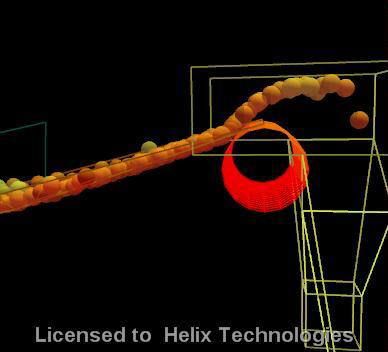
It's also worth checking the discharge trajectory against a dedicated trajectory calculator (such as the one in Helix Technologies' Helix delta-T conveyor design software) as an independent cross-check.